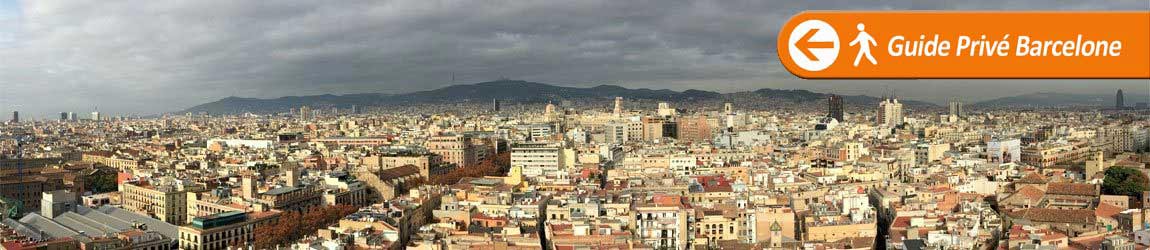
2026, a significant year for the Sagrada Familia
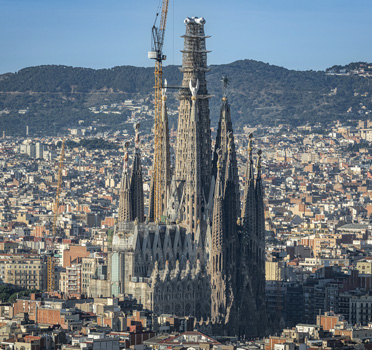
Sagrada Familia - February 2026
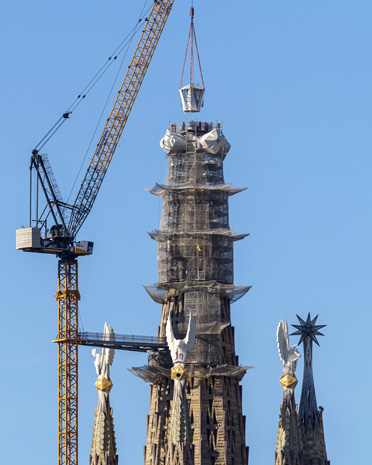
Installation of the last arm of the cross
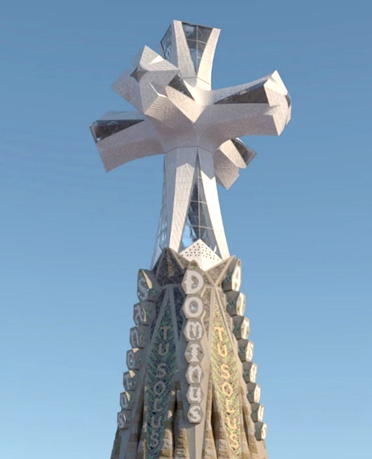
Monumental cross
Centenary of Antoni Gaudí’s death
2026 is a symbolic year in Barcelona, as it marks the centenary of the death of Antoni Gaudí, the visionary architect who transformed the building into a masterpiece of Catalan Modernism.
On June 10, 1926, Antoni Gaudí died after being hit by a tram on Thursday, June 7, on Gran Via de les Corts Catalanes, while he was on his way to the church of Sant Felip Neri to go to confession. This was one of the rare outings he allowed himself, since in 1914 he had decided to abandon all his projects, work exclusively on the Sagrada Familia, and withdraw into his workshop.
To celebrate this centenary, a rich program of events has been organized, culminating in a commemorative mass marking the centenary of the architect’s death, scheduled for June 10, 2026.
Visit of pope Leo XIV
An exceptional event will also mark 2026: Pope Leo XIV has confirmed an official visit to Spain from June 6 to 12, 2026, which will include Barcelona and the Sagrada Familia, where he is expected to preside over the inauguration of the Tower of Jesus Christ, the tallest tower of the basilica, as well as the commemorative mass marking the centenary of the architect’s death.
The temple of all records
After more than 143 years of construction since work began in 1882, the Sagrada Familia will complete the tallest of its towers in March 2026.
In February 2026, the Sagrada Familia reached a crucial moment in its history: the installation of the final element of the cross at the top of the tower dedicated to Jesus Christ allowed the basilica to reach its maximum height of 172.5 meters, making it the tallest building in Barcelona and the tallest church in the world, surpassing Ulm Minster in Germany, which stands 161.5 meters tall.
This final piece of the four-armed cross, the upper section, measuring 17 meters high and 13.5 meters wide, was lifted by a crane and then assembled at the top of the central tower, thereby completing the exterior of the main structure.
Before June, the scaffolding surrounding the top of the Tower of Jesus Christ will be removed, revealing the monumental four-armed cross, which will be visible from across the city. This gigantic cross is 29 meters high, equivalent to the height of an eight-story building, and weighs 13 tons.
The Sagrada Familia could have been much taller, but Gaudí decided not to exceed the height of Montjuïc hill (177 meters), thereby showing his respect for God’s creations, as he considered God to be the supreme architect.
A basilica still alive despite the centuries
Even though the building has now reached its final height and all the main towers have been completed, the work is not entirely finished. The interior and certain façades still need to be completed: sculptural elements, the Glory Facade and other architectural details will continue to be completed over the coming years.
The Glory Facade, the last of the three façades, is highly controversial: planned as the main entrance to the temple, it should be accessible via a monumental staircase, which would require the expropriation and demolition of several buildings and therefore involve a very significant cost.
Before June 2026, the city authorities will redevelop the access to the temple from Mallorca Street, as well as the square and the lake facing the Nativity Facade, where the entrance to the temple is located.
The area has been classified by the city council as an EGA, a high-traffic area, and the aim is to reconcile the needs of local residents with those of tourists. The Sagrada Familia receives 5 million visitors a year. Taking into account tourists who come to see the temple without visiting the interior, the city council estimates that 18 million tourists pass through this area every year.
-> The Sagrada Familia is a unique monument, open to multiple interpretations; to ensure its discovery is an unforgettable experience, we recommend visiting it with a private guide…
Guide Privé Barcelone
 Barcelona
Spain
☏ Tel: +34.678.227.453
180-320€
✉ Mail contact
BarcelonaSpain
☏ Tel: +34.678.227.453
180-320€
Travel & Hospitality Award
2020 & 2021

Guide Privé Barcelone
https://www.guideprivebarcelone.com/index.html
+34.678.227.453
https://www.facebook.com/guideprivebarcelone
https://twitter.com/GuidePriveBCN
https://www.instagram.com/guideprivebarcelone
https://www.tripadvisor.es/Attraction_Review-g187497-d8134648-Reviews-Guide_Prive_Barcelone-Barcelona_Catalonia.html
Guide Privé Barcelone
https://www.guideprivebarcelone.com/index.html